I recently started following a number of Substack accounts and one I particularly connect with is INTROVERT’S INTRO. I tried to figure out an easy way to embed a post but am too exhausted to make it happen today so I’m cutting and pasting. Yesterday’s post was titled:
THE INTROVERT’S PARADOX: WHY WE OVERSHARE, THEN REGRET IT FOREVER
The quiet after oversharing and how to overcome the overthinking spiral?
You know that feeling when you’re in a conversation, everything’s going fine, and then suddenly you’re three stories deep into something you never meant to share?
And the moment you finish talking, a quiet dread settles in.
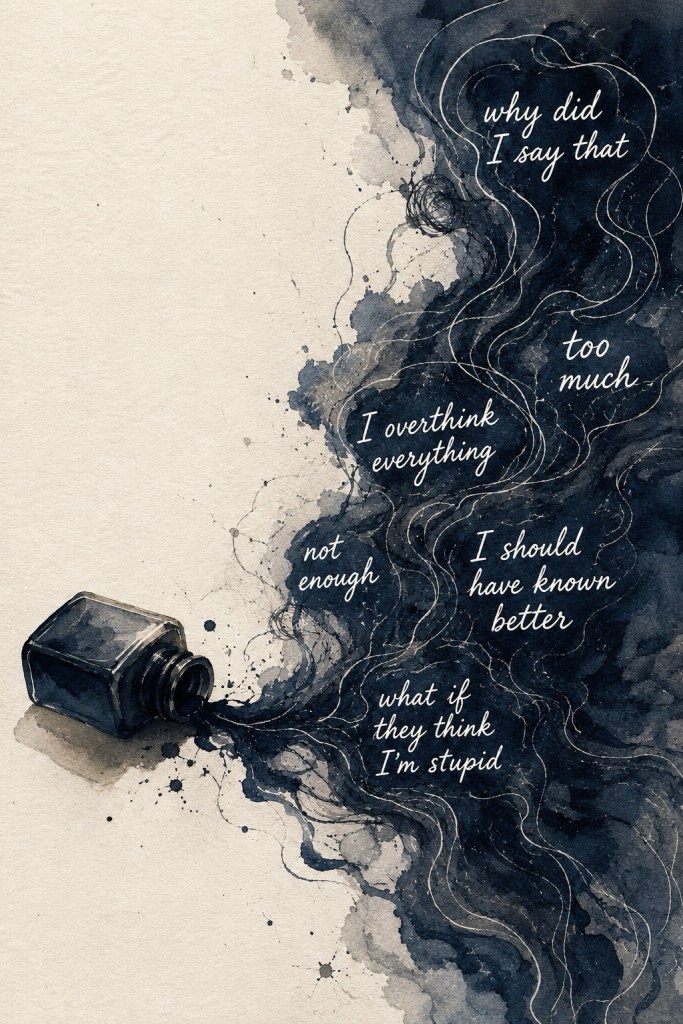
“Why did I say that?”
Or there’s a moment when you’re brushing your teeth. Or staring at the ceiling. Or halfway through your commute. And suddenly your mind replays it—
that sentence you didn’t plan to say,
that personal detail that slipped out too easily,
the joke that landed strangely.
For introverts, this isn’t just an awkward moment— it’s the beginning of a mental loop that can last days, months, or in some cases, genuinely years.
We replay the conversation like a courtroom cross-examination, analyzing every word choice, every facial expression we might have missed, every possible interpretation of what we revealed.
And the strangest thing?
Introverts are supposed to be the careful ones. The observers. The people who think before they speak.
So why do we sometimes do the exact opposite?
The Mechanics of Introverted Oversharing
Why Introverts Overshare (When They Don’t Mean To):
There’s a common assumption that oversharing is an extrovert trait — something done by people who speak first and think later. At the same time, introversion is often misunderstood as shyness or a dislike of people. But neither of those ideas is really true.
Introversion is more about energy than silence. And because of that, introvert oversharing tends to work differently.
There’s also another, lesser-known dynamic at play:
Many introverts process their thoughts externally once they finally feel safe enough to open up.
Think of it like a pressure valve.
We spend so much time in our heads—observing, filtering, holding back—that when we encounter someone who feels genuinely receptive, the valve opens. Sometimes it opens too far.
This explains the Introvert paradox: the same person who can go days without meaningful conversation will suddenly unload their entire internal world on a coworker, a new friend, or worse, a near-stranger who simply asked, “How are you really doing?”
When someone creates a moment of safety for us—
a thoughtful question, a genuine pause, a sense of being seen, then the internal valve opens and we speak our heart out.
Not because we crave attention, but because we crave meaning.
The conversation feels rare. Real. Worth investing in. And in that moment, the filter that usually protects us relaxes just enough for something personal to slip through.
By the time we realize it, the words are already out there.
But,
The Real Problem Isn’t Oversharing. It’s What Comes After.
Oversharing itself is rarely the issue. The issue is the mental aftermath.
Introverts don’t just remember conversations—we archive them.
We replay tone. Facial expressions. Micro-pauses. We imagine alternative versions where we said less, said it better, or said nothing at all.
Introverts are highly attuned to social dynamics.
We care deeply about how we’re perceived, not because we want approval, but because we value harmony and psychological safety.
So when we overshare, it can feel like we’ve violated our own boundaries.
And the mind responds by replaying the scene endlessly—as if repetition could rewrite the past.
The Hidden Function of the Replay Loop
Here’s the part most people miss:
The replay isn’t punishment. It’s protection.
Your mind is trying to learn.
Each replay asks a quiet question:
“How do I keep myself safe next time?”
But without guidance, the brain defaults to self-criticism instead of self-correction.
So instead of extracting insight, we relive embarrassment. Instead of building better boundaries, we build shame.
The loop keeps spinning—not because we’re broken, but because the lesson hasn’t been clearly translated.
Oversharing Is Often a Boundary Blur, Not a Personality Flaw.
When an introvert overshares, three things happen simultaneously:
- You violate your own boundaries: We Introverts have an internal sense of how much to reveal, and we crossed it. This isn’t about what the other person thinks—it’s about betraying our own operating system.
- You lost control of the narrative: Introverts are editors by nature. We curate what we say. Oversharing means we published the rough draft, and now it’s out there, unedited, forever.
- You exposed yourself to uncertainty: The worst part isn’t what we said—it’s that we don’t know what the other person did with it.
Did they judge us? Pity us? Tell someone else? We handed them information and lost control of what happens next.
This is why the replay loop is so persistent.
We’re not just cringing at what we said. We’re trying to retroactively regain control of a moment that’s already gone.
That doesn’t make you careless. It makes you human—and reflective.
When you overshare and then spiral, your nervous system is telling you something important. Usually one of two things:
You’re starved for connection: If you find yourself oversharing regularly, it often means your baseline level of meaningful interaction is too low. You’re not feeding the need for authentic conversation, so when the opportunity arises, you binge.
You’re with the wrong people: If you overshare and regret it in specific contexts—certain friends, work environments, family gatherings—it might not be about you at all. It might be that these spaces aren’t safe enough for the level of openness you naturally want to express.
The goal isn’t to shut yourself down or become less open. It’s to develop internal pacing: the ability to notice when something is forming inside you, and decide whether this moment deserves it.
That skill doesn’t come from self-judgment. It comes from awareness.
_______________
The article continues on with ideas on how an introvert can protect themselves from oversharing if it’s hurting them and what to do if you’ve already overshared.
My reputation within my family and friends and acquaintances is that I am the talkative one. I appear to be an extrovert when I am most decidedly an introvert. I’ve taken the personality tests numerous times. INTJ.
https://www.16personalities.com/intj-personality
That’s me. Oversharing takes a HUGE toll on me.
A few years ago my mom asked me when I had become so talkative. I was a silent child. Always observing, rarely sharing. I was a quiet student in school. Always high marks for listening and absorbing. Straight A’s, but never standing out in the crowd.
Well, I do believe I know now what created this fracture of my personality. This change in how I handled the world because I’m not a shy or insecure person but I was for a very long time, a very controlled and disciplined person. What happened is my partner wasn’t there for me, physically much of the time, but more importantly, emotionally. I was living inside my head, longing for a deeper connection to my best friend. And to the outside world I was filling in all the gaps, oversharing and desperately seeking connections to replace the most important connection I was missing. My partner didn’t share a big part of his life with me and my body knew it and my mind was plastering over the cracks. And when the truth was revealed, the whole thing came crumbling down. It seems so obvious now, but it didn’t then.
I still seek a deeper connection with Blue Eyes. He doesn’t really listen to me much of the time and he still fills his voids with external validation. I have learned to live with it most of the time and I’ve tried to better understand myself in the process but sometimes it just sucks.


You’re blogging again! Hi there! I crave that meaningful connection too. I have overshared way too much with the wrong people; I thought (for me) it was a trauma reaction. I suppose I wanted to be *seen* too, but then I never felt good after. Humans are wired for connection. I suppose I will continue to nourish friendships.
LikeLiked by 2 people
I think about blogging a lot, but rarely do. I’ve fairly well lost interest in social media as well. It’s a wacky time and I’m so exhausted from dealing with family issues. I crave peace and quiet, which is hard to find these days. xo
LikeLiked by 1 person
👏👏👏
I get this. I’m not quite the same, as I thought I had a very deep, close connection with my best friend. Thought the intimacy was mint.
But, knowing you at least a little, and as I have a recent autism diagnosis, bringing eldest daughter energy, I hear this.
Loudly.
I described myself most of my life as an extroverted introvert. I knew I needed my cave time. And was often scolded for this. Especially post Dday, by my betrayer.
The oversharing is deeply uncomfortable, and very exhausting when it occurs.
Thanks for sharing this, Kat. It speaks to me, too. Sending hugs xxx
LikeLiked by 2 people
I’ve identified the issue, but what now? I still crave meaningful dialogue that rarely happens. It seems BE and I are in a pattern now. By the time he carves out time for me, I’m over it! 🤷🏻♀️ 🤗
LikeLiked by 1 person